Category: Uncategorized

  • Why Does the Perfectly Coded App Get 1-Star Reviews?

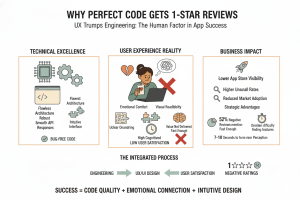
    Even the most reliable, bug-free, and beautifully developed mobile application may still find itself with a long list of 1-star rated reviews. The discrepancy between technical achievements and user experience is not an exceptional case anymore. The current user does not consider code quality but the emotional comfort, visual readability, value delivery, and experience that a person is offered when using the app for the first time. In a rapidly changing market, a product with perfect code can fail simply because it does not align with users’ mindsets, behaviors, or perceptions of design symbols.
    1. Code Quality Doesn’t Guarantee User Satisfaction

    A development team may deliver flawless performance, smooth API responses, and robust architecture, yet feedback still reflects dissatisfaction. Users do not evaluate code—they evaluate moments, micro-interactions, and clarity. Even minor friction points, unclear UI logic, or intrusive flows can overshadow technical excellence. This phenomenon is why businesses today rely on insight-driven teams from an app development company that understand both engineering and behavioral patterns.

    Why Users Feel Unhappy Despite Perfect Engineering

    • Unclear Onboarding Journeys: When users cannot immediately understand what the app does, initial frustration grows quickly.
    • Invisible UX Gaps: Smooth code doesn’t prevent emotional friction—poor labeling, inconsistent patterns, or confusing layouts cause instant drop-offs.
    • Value Not Delivered Fast Enough: Users expect quick wins; an app that delays benefits feels inefficient regardless of its stability.

    Business Impact

    • Lower app store visibility due to rating algorithms.
    • Higher uninstall rates within the first hour.
    • Wider gap between development effort and market adoption.

    2. UX Triggers That Lead to Negative Ratings

    A perfectly coded app may underperform because of design triggers that users interpret differently. What seems “minimalist” to a team may feel “empty.” New users may find what developers refer to as “feature-rich” to be “complicated.” Today, companies often consult an app development firm to address behavioral insights beyond the code layer.

    Common UX Triggers Behind 1-Star Reviews

    • Unoptimized Navigation Structure: If the hierarchy doesn’t match user mental models, frustration occurs almost instantly.
    • High Cognitive Load: Too many decisions or ambiguous paths make the experience tiring.
    • Poor Feedback Loops: Missing animations, loading states, or haptic confirmations make an app feel broken.

    Supporting Research Trends

    • Studies reveal that 52% of app deletions happen due to UX friction, not performance.
    • 40% of negative reviews mention difficulty finding key features.
    • Users form a perception within 7–10 seconds of opening an app.

    3. Expectations Shape Ratings More Than Functionality

    Most users compare every digital experience to category leaders like Uber, Spotify, and Instagram. This means even niche products must meet global expectations in speed, consistency, and simplicity. Businesses collaborate with a mobile development company to align their interfaces with patterns users already trust.

    What Drives User Expectations Today

    • Benchmarks Set by Global Apps: Users expect the same smoothness and clarity even from smaller products.
    • Real-World Usage Context: Poor network conditions, distractions, or shared devices distort perceived performance.
    • Design Familiarity: When an app deviates from widely accepted UI norms, users assume it’s flawed.

    Why Simpler Apps Sometimes Win

    • Fewer features reduce cognitive load.
    • Limited options streamline decision-making.
    • Familiar layouts reduce learning time.

    4. The Experience After Installation Matters More Than the Build

    Even if the app passes QA flawlessly, post-installation friction shapes user emotions. This is where many teams discover that negative reviews stem from overlooked experience details, not shortcomings in engineering. Businesses often rely on a mobile app development company to refine journey maps and reduce these hidden pitfalls.

    Key Post-Installation Factors Affecting Ratings

    • Onboarding Length: Users uninstall apps that ask for too much too soon.
    • Notification Sensitivity: Aggressive alerts immediately degrade sentiment.
    • Accessibility Oversights: Missing contrast, poor tap targets, and weak typography hurt usability.

    5. Design Language, Visual Hierarchy & Emotional Feedback

    Great engineering becomes irrelevant if users struggle visually or emotionally. This is why teams partner with a mobile application design company to ensure that the interface communicates clearly and guides users effortlessly through tasks.

    Critical Design Elements That Influence Reviews

    • Hierarchy Clarity: Users must instantly see where to go next.
    • Visual Rhythm: Consistency in spacing, alignment, and components creates comfort.
    • Micro-Interactions: Small animations help users feel the app is responsive and reliable.

    6. Trust, Security Cues & Perceived Professionalism

    Apps that appear “basic” or “unfinished” visually—even if they are technically sound—lose trust. Thoughtful UI choices, polished interactions, and familiar patterns signal reliability. This is why product teams increasingly work with a mobile app development agency to refine micro-gaps that influence perception.

    Elements That Build or Break Trust

    • Visual polish
    • Consistent iconography
    • Predictable gestures
    • Clear error messages

    7. Why Product Teams Must Map Real User Behavior

    Engineering insights alone cannot reveal emotional friction or perception gaps. User testing, usability mapping, and experience analytics are essential. Teams often collaborate with a mobile application development agency to create behavior-driven improvement cycles.

    What Behavior Mapping Reveals

    • Path deviations
    • Confusion points
    • Drop-off hotspots
    • Feature misunderstanding
    • Emotional reactions to UI patterns

    8. Ratings Improve When UX, UI & Engineering Work Together

    The strongest apps integrate design, engineering, psychology, and product strategy. Stability is only one ingredient. Users reward clarity, comfort, familiarity, and intuitive flows. Many enterprises now work with an enterprise mobile app development company to bridge these layers.

    When Engineering and UX Are Aligned

    • User trust increases
    • Friction reduces
    • Retention improves
    • Ratings rise organically

    9. Visual Identity & Interaction Quality Shape Long-Term Perception

    An app can be functional yet feel unpolished. Seamless transitions, minimalist designs, and branded consistency influence the satisfaction of the user even after installation. This is where several companies will turn to a mobile application design firm in order to streamline and update the visual system.

    Long-Term Design Factors

    • Motion design approach
    • Brand-consistent components
    • Clear, readable type systems
    • Accessible color schemes

    Conclusion: Technical Excellence Is Only Half the Story

    Even a perfectly coded application will not assure a good rating, as the perception of the users is influenced by the sense of clarity, emotional comfort, and intuitive interface rather than the quality of the engineering. When businesses match UX, UI, and technical implementation, they develop products that are easy to touch, trust, and feel valuable. The successful app is a well-constructed application that appeals to the actual user behavior and conveys the value immediately.

    When you are enhancing an existing product or even developing a new product, you should focus on the integrated process of design-engineering. An easier and more natural experience can only result in better ratings and sustainable user satisfaction.

  • The Ultimate Guide to BDD with Cucumber and Selenium

    The modern world of software development is a fast-paced environment, where the partnership and understanding between the technical and non-technical departments are the keys to success. This is the place where the concept of Behavior-Driven Development (BDD) comes in. BDD is not merely a different method of testing; BDD is rather an attitude that fills the gap between the developer, tester, and the business stakeholders.

    The basic concept of BDD is a simple one, which is writing tests that explain how a system behaves in a simple and human-understandable language. This facilitates easier understanding of all the stakeholders as to what is being constructed and the reasons. BDD is also effective because it helps to make development closely match the business objectives, user requirements, and system expectations since it puts emphasis on the what and not the how.

    BDD is based on natural language constructions, such as Given-When-Then, with the help of which test scenarios are formulated. This ease enables other members of a team who are not technical to be involved in test development and test validation. It eradicates the ambiguity and aids in the detection of misunderstandings by the teams prior to the commencement of coding.

    This strategy is even more potent when it is combined with automated testing software such as Selenium and frameworks such as Cucumber. Combined, they enable these natural-language situations to be automated, transforming the specifications that a business can read into a runnable test. The result? Shorter feedback loops, better quality software, and increased confidence at the time of releases.

    In the modern Agile and DevOps environment with frequent updates as a regular practice, the BDD approach has proven to be the means of transparency, collaboration, and accuracy throughout the entire development process. It promotes a common ground—it is easier to provide the appropriate functionality at the appropriate time.

    How Cucumber and Selenium Work Together

    Cucumber is a common BDD framework, which is used to support plain English executable specifications. It also reads test scenarios that are in Gherkin syntax—a language that organizes tests in the Given, When, Then format. The magic is that when these steps that humans can read are connected to the automation code that runs them, they get executed.

    Conversely, Selenium is also a tool that has the capability to automate web browsers. It enables testers to communicate with web objects, test functionalities, and act like a user, without the need to do it manually. Cucumber and Selenium are complementary to one another since they provide a smooth combination of automation and readability.

    Here’s how this synergy works:

    1. Writing Scenarios: Scenarios are clear and brief scenarios written by the business or QA staff in Gherkin.
    2. Mapping Steps to Code: These are the scenarios connected by developers to Selenium automation scripts that execute the actual browser interactions.
    3. Running Tests: Cucumber is used to run these tests, which are performed using Selenium when performing user actions and validations on the web application.
    4. Generating Reports: Cucumber is used to run these tests, which are performed using Selenium when performing user actions and validations on the web application.

    This combination enables teams to utilize an active documentation process—that is, test scripts not only contain documentation of system behavior but also serve as documentation of system behavior. With each evolution of the application, the Cucumber tests also evolve to keep the business requirements in line with the reality on the ground.

    Firms that provide Selenium automation testing services are using this integration as a way of providing high-quality, maintainable, and robust automation structures. Such services allow shorter release times and also make sure that overall updates to business logic and user journeys are the same.

    Advantages of Implementing BDD with Cucumber and Selenium

    Combining Cucumber and Selenium in a BDD environment has far-reaching advantages to both the development process and the test process. Let us look at some of the most influential ones:

    1. Enhanced Collaboration: Combining Cucumber and Selenium in a BDD environment has far-reaching advantages for both the development process and the test process. Let us look at some of the most influential ones:
    2. Clear Requirements and Documentation: Combining Cucumber and Selenium in a BDD environment has far-reaching advantages to both the development process and the test process. Let us look at some of the most influential ones:
    3. Early Detection of Defects: BDD promotes communication prior to the commencement of coding and assists in revealing a misconception earlier. Selenium tests with automated Cucumber Selenium can also be used to identify functional problems at an integration level and reduce bugs during production.
    4. Increased Test Reusability: Cucumber has reusable test steps and is, therefore, efficient and easy to maintain. Such common actions as logging in or scrolling through the app can be reused in a variety of test scenarios.
    5. Continuous Integration and Delivery: Cucumber and Selenium are both integral to CI/CD pipelines since they are automation-based. This helps teams to confirm new features immediately and ensures all deployments are functionally sound.

    Organizations leveraging Selenium testing services often adopt this BDD approach to ensure both technical accuracy and business clarity. It’s not just about automation — it’s about aligning development with real-world expectations.

    Building a Successful BDD Strategy with Selenium and Cucumber

    This BDD is a commonly used approach by organizations that require the services of Selenium testing to maintain the accuracy of the technical and clarity of the business. It does not just concern automation; it concerns matching development with the actual world’s expectations.

    Here are the key elements to ensure a successful implementation:

    1. Align Teams and Roles: Start with some of the key features or modules and then proceed to implement BDD in the whole system. This assists teams in learning the working process, working out standards, and establishing the automation system cost-effectively.
    2. Start Small, Then Scale: Start with some of the key features or modules and then proceed to implement BDD in the whole system. This assists teams in learning the working process, working out standards, and establishing the automation system cost-effectively.
    3. Write Clear, Testable Scenarios: Gherkin scripts should not be too complicated. The scenarios must be user-behavior-user-outcome-oriented and not implementation-oriented. The more evident the situation, the more sustainable it will be.
    4. Integrate with CI/CD: Continuous integration for Cucumber-Selenium tests. All commits must be followed by automated checks, which require prompt feedback and validation.
    5. Maintain and Refactor Regularly: The test scenarios should be changed as the applications are changed. Frequent updates discourage obsolescence. 

    The future of software testing is in collaboration, transparency, and quality assurance based on automation. The integration of these tools and practices will enable businesses to become innovative and provide the user with products that they can use.

    Conclusion

    BDD, Cucumber, and Selenium would be the ideal combination of the three aspects of clarity, collaboration, and automation. It enables teams to author meaningful tests that capture real-world user behavior and to change very quickly. In companies that aim at enhancing the quality of software and the communication at the organizational level, this strategy is the assurance that all the stakeholders will speak the same language, the language of common goals and effective results.


  • Selenium 4.20 Release Highlights for Testers in June 2025

    Selenium 4.20 Release Highlights for Testers in June 2025

    The testing environment is fast evolving, and Selenium 4.20 is one of the tests with interesting changes that a quality assurance expert must be aware of. The new version will be available in August 2024 and will be accompanied by important changes that will allow expanding the testing capabilities and facilitate automation workflows. Teams that would like to remain competitive would find it vital to understand such changes so as to have healthy testing strategies.

    Key Highlights that Change Testing

    Improved support of Chrome DevTools

    Chrome DevTools versions 122, 123, and 124 are new on Selenium 4.20, whereas in Firefox, they are still using version 85 in all versions of browsers. This increased compatibility leads to increased reliability of cross-browser testing and decreased conflicts related to version. The improved integration of the DevTools enables the tester to get the benefit of advanced debugging tools without leaving their automation scripts.

    The professional Selenium automation testing services use those DevTools enhancements to offer more detailed testing services. The improved debugging features allow determining the performance bottlenecks and network problems faster than the previous versions.

    WebDriver BiDi Protocol Developments

    The two-way protocol support has kept on growing in Java and JavaScript implementations. This improvement facilitates the real-time exchange between browsers and test scripts, and this allows new opportunities to be opened to dynamic testing scenarios. The testers are now able to check console logs, intercept network requests, and process browser events.

    The BiDi advances are a major milestone towards more interactive and responsive test automation. Teams that use the Selenium testing services have shorter testing times and more confidence in complex testing environments.

    Selenium Manager Refactoring

    All programming languages have been fully refactored in the code, referring to calling the Selenium Manager. This modification simplifies maintenance and improvements on the system but is likely to create compatibility problems with users who were directly calling the Selenium Manager. The refactoring provides improved long-term stability and optimization of performance.

    As Selenium Manager is still in beta, such architectural changes are normal and required in order to improve it later. The changes are aimed at the easier management of drivers and a less complex setup of development teams.

    Language-Specific Improvements

    Java Enhancements

    Java developers benefit from a few new improvements in the 4.20 version. Currently, browser containers in Dynamic Grid will support hostConfig settings, which give improved resource management and deployment flexibility. Dynamic Grid also redownloads browser images automatically in case they were pruned at runtime, which allows similar test environments.

    Several BiDi extensions to Java are present, such as new browsing context creation methods. Such enhancements result in a less fragile and feature-rich Java-based test automation for enterprise applications.

    JavaScript Updates

    BiDi enhancements are greatly provided on JavaScript implementations, especially screenshot capture APIs. The new APIs contain all the required parameters, with the exception of the scroll parameter that simplifies the screenshot process. Also, nightly JavaScript builds can be accessed via GitHub packages, allowing the use of the most advanced features.

    Incorporation of these advancements enables teams that recruit Selenium developers with knowledge of JavaScript to develop more advanced testing solutions. The improved screenshot feature is especially useful when it comes to visual regression tests.

    Updates of .NET and Python

    A very serious bug was fixed whereby the .NET implementation uses DevTools session IDs properly after reinitialization, making tests more reliable. GitHub packages also have nightly .NET C# builds, and developers have access to the latest features and bug fixes.

    The Python developers can enjoy better type hints in parameters, which improves the readability of code and IDE support. Such enhancements ensure that Python-based test automation is easier to maintain and has minimal chances of causing runtime errors.

    Enhancements of Grid Architecture

    Dynamic Grid Functionalities

    Selenium Grid 4.20 offers new dynamic provisioning with support for automatic administration of the browser containers. This enables the system to manage the images in the browsers in a smarter way so that there is less manual intervention and more reliability of the test execution. These are especially useful to the teams that are executing large test suites.

    The improved Grid architecture facilitates the improved usage of resources and the capability of scaling. The companies that employ remote Selenium developers have a chance to take advantage of these advancements and create a more effective distributed testing framework.

    Better Debugging and Monitoring

    The newest release offers improved support for trace logging and session management. Through these enhancements, the teams can detect and fix problems faster when carrying out tests. The increased monitoring feature gives more information about how the tests are being performed and the consumption of resources.

    Improvements on Performance and Reliability

    More User Base

    Selenium currently has more than 2.3 million active users during the past 30 days, which is 500,000 up as compared to the previous month. Such an increase proves the fact that the platform remains relevant and is used by the testing community. There is also an increasing user base that makes the ecosystem of tools and resources significantly stronger.

    Nightly Build Tests

    Every nightly package is tested daily by taking case studies from official Selenium documentation. This is a strict kind of testing, and it will keep the new features and bug fixes of high quality before they are finally released as stable versions. The examples of documentation are tested automatically, which helps to keep the accuracy and reliability.

    Migration Considerations

    Interface Changes

    The Selenium Manager interface has been modified drastically, and this may cause problems for users who were calling it directly. Teams are advised to look at the automation scripts that they have and make some updates to the direct call to the Selenium Manager to make them compatible. Due to the fact that Selenium Manager is in beta, it is normal to have such changes.

    Best Adoption Practices

    It is advisable that organizations devise a strategy on how they will migrate to Selenium 4.20  by ensuring that critical automation scripts are tested first in the staging environment. These new features are very useful, yet appropriate testing allows easy integration so as not to disturb the current workflow.

    Future Outlook

    Ongoing BiDi Development

    WebDriver BiDi protocol will proceed to get improvements in all language bindings. The future versions will have even stronger automation and improved integration with browsers.

    Community Growth

    As the user base and the community of developers working with Selenium are growing, Selenium keeps consolidating its status as the number one web automation framework. The fixed update schedule will prove to make it constantly better and capable of adjusting to the shifting web technologies.

    Conclusion

    The new version of Selenium 4.20 brings significant changes that improve the possibilities of testing in all available languages and platforms. The increased support of the Chrome DevTools, enhanced BiDi protocol features, and enhanced Grid architecture make the release especially useful to modern test teams. These updates are more reliable, perform better, and have more debugging features that are worth the investment that organizations make in quality automation.

    The support of the language-specific features and the refactored Selenium Manager proves the desire to make the project long-term maintainable and with a positive developer experience. With web applications getting more and more sophisticated, such improvements make Selenium the ultimate solution of choice when it comes to overall test automation strategies.